I have an elderly aunt who lives in North Carolina. She is one of the last living connections I have to my biological father, who died when I was four years old. She sends birthday wishes on Facebook, likes photographs of family celebrations, and replies to posts with emojis. She is devout, has spent her life looking after others, and is, by any measure I can apply, a good person.
She also shares something else entirely. Alongside the nostalgic photographs and the genuinely moving posts about overcoming injustice, there is a steady, daily stream of material that is harder to reconcile with the person I had always assumed her to be. Pro-life content. Evangelists who explain with calm authority that there are only two sexes, providing the theological scaffolding for cruelty toward trans and gay and neurodiverse people. Posts presenting immigrants as criminals, or worse. And yes, Trump-as-messiah images. Videos of evangelists arguing that God is using Trump in ways we cannot understand. The President surrounded by people praying over him in the Oval Office, the staging unmistakeable, the intention worse. These are not occasional lapses. They arrive with the regularity and conviction of someone who has found their church.
I could not stay silent after one particular post. I wrote something careful, rooted in scripture rather than contempt, and said simply that I was uneasy when power and righteousness are conflated, that scripture itself warns against exactly this, and that I was not telling anyone what to think. She responded thoughtfully. We have not discussed it since.
I think about her often when I try to understand what is happening in America.
A colleague I worked closely with in London, someone I respect and whose judgment I trust in most things, once told me he was a fan of Trump. He admired what he saw as someone who got things done. It did not end our friendship but it has never entirely left me. Because this man is intelligent, diligent, experienced and thoughtful. He is not susceptible to obvious manipulation. And yet.
That word. Yet.
It sits at the centre of everything that is most disturbing about this moment. Yet a third of America looks at everything and says yes. Yet people I care for and respect arrive at conclusions so different from my own. Yet the evidence accumulates, the behaviour worsens, the damage compounds, and the worship intensifies rather than diminishes.
A British writer named Nate White wrote an essay during Trump’s first term that went viral twice. I agreed with every word of it. But I keep returning to what it cannot account for, which is everything that has happened since. The first term was alarming. What has followed is of an entirely different order. The institutions, the alliances, the social norms that took generations to build have not merely been challenged. They have been systematically dismantled, and the pace has been deliberate. White’s essay identified the fractal nature of Trump’s flaws with precision and wit. What it could not anticipate was the scale of what those flaws, unchecked and rewarded, would eventually produce. The essay no longer goes nearly far enough. I intend to go further.
Any single one of Trump’s acts, taken in isolation, would have ended any other political career in any functioning democracy. A single lie of this magnitude. A single act of this cruelty. A single statement of this ignorance. Any one of them, for any other public figure, would have been terminal.
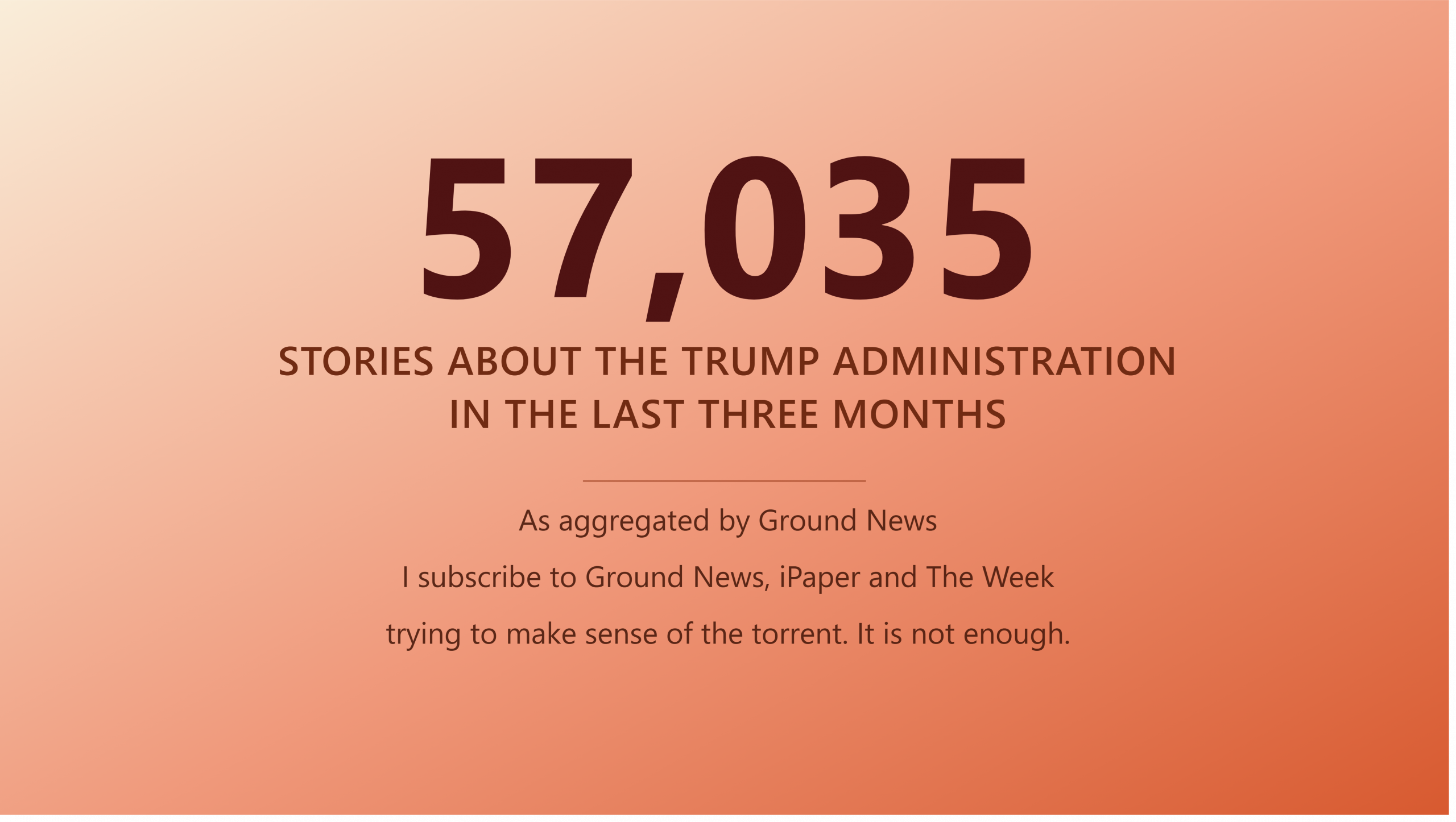
But they do not arrive in isolation. They arrive in a torrent.
And the torrent is the strategy.
The sheer volume and velocity of outrages, arriving faster than any individual or institution can process them, is how accountability becomes impossible. By the time one transgression is being examined, three more have replaced it. The news cycle moves on not because journalists are negligent or the public is indifferent, but because the architecture of the assault is designed to exhaust. Shock and awe as a doctrine was developed to overwhelm an enemy’s capacity to respond. It works equally well applied to the collective moral attention span of a civilisation.
What has made this moment uniquely dangerous is that the torrent did not stay within America’s borders. It was always going to travel. What nobody fully anticipated was how actively it would be carried.
Elon Musk, the wealthiest man in the world, has used his ownership of a global information platform to openly support far right movements across Europe. He has amplified figures like Tommy Robinson in Britain and endorsed Nigel Farage and Reform. JD Vance has made interventions into European politics that would have been unthinkable from an American Vice President a decade ago. The message from Washington is no longer simply that America is moving rightward. It is that the movement expects company and is willing to help recruit it.
This is not organic. It feels, and increasingly looks, like coordination. The same talking points, the same targets, the same contempt for the institutions designed to provide scrutiny and accountability. Checks and balances were built precisely to contain this kind of concentrated, ideologically driven power. Those checks and balances are being weakened in America and tested everywhere else simultaneously.
Nigel Farage has waited a long time for this moment. He has been wrong publicly, laughed at, dismissed, and has kept going. Trump’s success was his validation. Reform’s rise is the consequence. What is happening in British politics is not a coincidence or an independent development. It is the same permission structure operating in a different postcode.
Yuval Noah Harari has written about the information conditions that make all of this possible. In a completely free information fight, truth tends to lose. The tools that were supposed to democratise knowledge have instead created an environment where the wealthiest and most powerful can pollute the information landscape at a scale and speed that no correction can match. My aunt in North Carolina is not an aberration. She is the intended audience of a very old strategy, delivered through very new tools, and reinforced daily by an algorithm that has no interest in her wellbeing and every interest in her engagement.
The damage is not only political, though the political damage is vast. The deeper damage is cultural and social. The playground bully did not just win an election. He demonstrated, at the highest possible level of visibility, that cruelty is not punished, that lies are not corrected, that the rules everyone else is expected to follow do not apply if you are bold enough to ignore them. That lesson has been absorbed. You can feel it in how people speak to each other, what they believe they can say, what they think they can get away with. It is changing the texture of daily life in ways that will outlast any single presidency.
I do not feel contempt for my aunt or for my London colleague. What I feel is harder to name and harder to carry. It is something closer to grief, watching people I care about and respect arrive at conclusions so different from my own, and understanding that no argument I could make, however careful, however rooted in the values they themselves hold, will change that. My Facebook comment changed nothing. I knew it would change nothing when I wrote it. I wrote it anyway, because the alternative was silence, and I have never believed that evil requires anything more than good people looking the other way.
Trump is not the cause. He is the proof. He is the demonstration that a system built on norms as much as laws, on the assumption that those who hold power will exercise a basic minimum of good faith, is catastrophically fragile when someone decides simply not to. The question that will define the next generation is not whether he can be stopped. It is whether the lessons are learned. Whether the gap between what happened and what was supposed to be impossible is finally, honestly examined. Whether the systems that failed can be rebuilt before the next test arrives.
I am not willing to look away. I am not willing to pretend this is normal. And I am not willing to stop believing that it matters that some of us refuse to accept it.
On this site
Why Some British People Don’t Like Donald Trump – Nate White – facsimile of the essay referenced in this article, preserved here because the original Quora post is no longer available.
Influences: Yuval Noah Harari — The Harari quote referenced in this article is discussed further here.