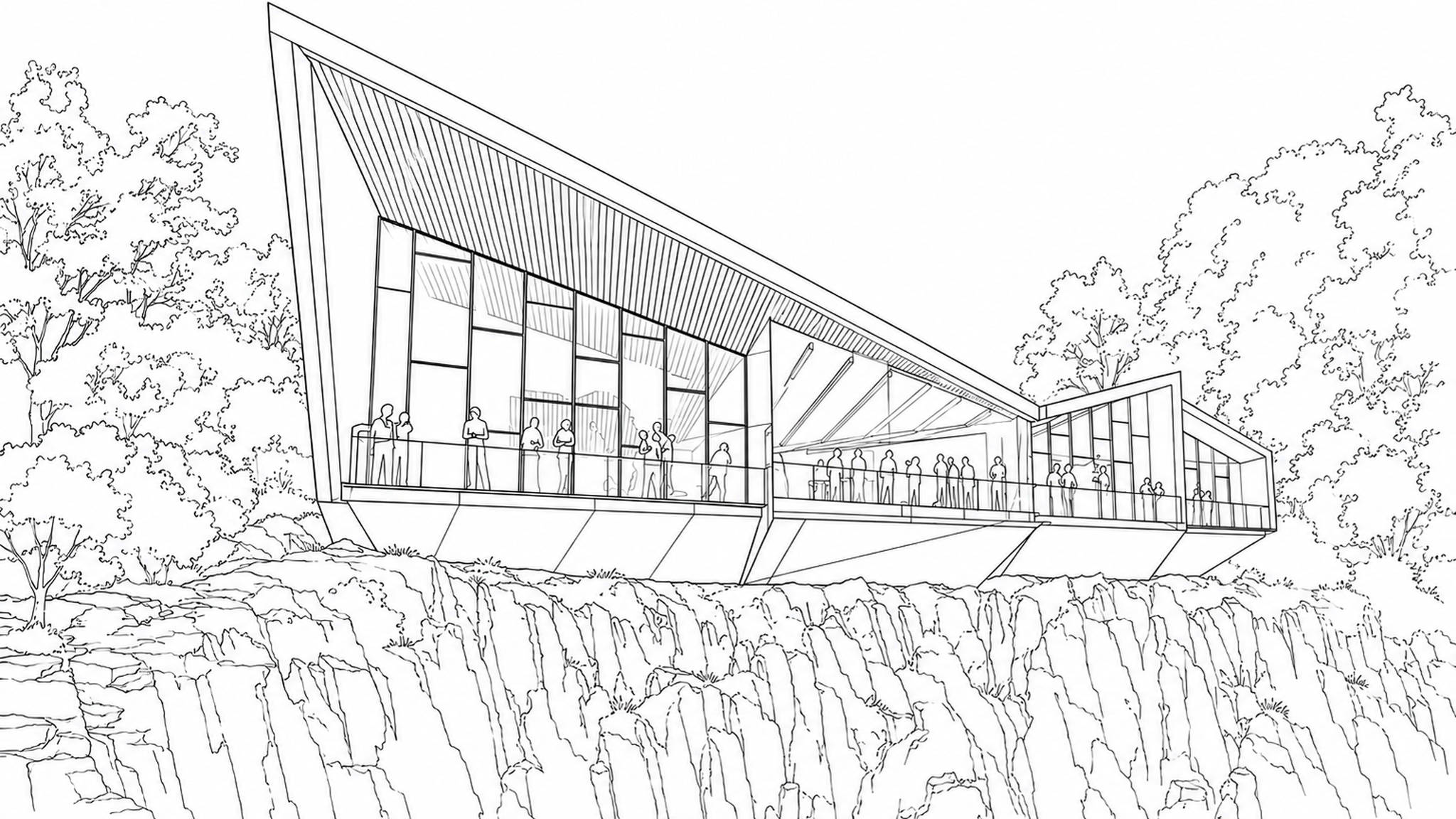
This is the fifth in a series of articles about Aberdeen. If you have arrived here first, the earlier pieces are worth reading before this one.
There is a vast hole in the middle of Aberdeen that most people know about but almost nobody has properly seen.
Rubislaw Quarry sits half a mile from my home. I have walked past it many times and once climbed an old path from the Queen’s Road side as far as a padlocked gate and rusty fencing. You can get close but you cannot see in. The perimeter is dense with planting and the broken fencing reveals nothing of what lies beyond. There is no view available to the public of what sits on the other side, one of the largest man-made holes in Europe, 450 feet deep, filled with dark water, surrounded by the city on three sides and a business park on the fourth. A handful of houses look down into it from one section of the rim. The rest of Aberdeen knows the quarry exists. Almost none of them have seen it properly.
Two days ago I saw it clearly for the first time, through drone footage posted on Instagram [1]. The camera circles the site from above, the quarry always in the centre of the shot, the city visible all around it, houses, offices, roads, trees, going about its business around something extraordinary that has never been made accessible to the public. I could see my own house in the distance. I could see offices I have worked in.
The quarry supplied the granite that built Aberdeen and much of what surrounds it beyond the city too. Marischal College, the second largest granite building in the world. Waterloo Bridge in London. The terrace of the Palace of Westminster. The Forth Rail Bridge. Six million tonnes of stone extracted over two hundred years, by men working in conditions that were, by any account, tough, dangerous and physically demanding. Operations ended in 1971. Since then the pit has slowly filled with water, the fencing has gone up, and the city has been waiting for someone to decide what to do with it.
Hugh Black and Sandy Whyte bought Rubislaw Quarry in 2010. The names are, genuinely, as unlikely as they sound, and the project they had in mind matched them. They wanted to build a heritage centre on the quarry rim, using reclaimed Rubislaw granite on the facade and glass at the rear to give views down into the water. A £6 million celebration of the city’s granite history, perched on the edge of one of the most extraordinary industrial landscapes in Scotland.
When I first came across the artist’s impression I felt something I hadn’t felt about Aberdeen in a long time. It looked genuinely beautiful. It looked like something worth coming back for. It looked like something a city with Aberdeen’s history had every right to be proud of.
Sandy Whyte died before he could see it built. Hugh Black fought on, through planning applications, through a five-day Lands Tribunal hearing in 2017 that ruled against him, through years of legal obstruction [2]. Meanwhile a Canadian developer called Carterra applied twice to build luxury flats on the north edge of the same quarry. Aberdeen City Council rejected the plans twice, unanimously, against their own planning officers’ recommendations, with over 400 letters of public objection. The Scottish Government overruled the council both times and approved the flats [3]. Hugh Black called the decision shameful. He said it showed no respect for the city or its residents.
Hugh Black was not the only person with a serious vision for the site. In 2019, architect George Simpson proposed something more radical still: recycling a decommissioned jack-up oil rig as the centrepiece of a visitor attraction combining the history of Aberdeen’s granite and North Sea oil industries, with underwater restaurants and diving bell trips into the flooded quarry below. [6] Simpson argued that a heritage centre alone was unlikely to compete with the V&A Dundee as a major visitor destination, and that the quarry deserved something with the ambition to match its scale. It was an extraordinary idea. It went nowhere.
The flats have not been built. The heritage centre has not been built. In late 2023, Hugh Black put the quarry up for sale [4]. As of September 2024 it remains unsold, in stalemate, the Scottish Government categorising its redevelopment potential as “uncertain” [5].
A man with a vision spent over a decade fighting for it, lost, and eventually gave up. A developer with no connection to the city got permission for something nobody wanted, and didn’t build it either. And the quarry sits as it has always sat, full of dark water, surrounded by broken fencing, visible to almost nobody, half a mile from my front door.
Rubislaw Quarry is the most visible example of something that runs through this city like a fault line. The same pattern appears at Broadford Works, the largest collection of A-listed buildings in Scotland, derelict for over twenty years in the heart of the city, its most recent redevelopment plans quietly abandoned in January 2024 [7]. At Woolmanhill Hospital, open for nearly 270 years before the NHS moved out in 2017, A-listed and deteriorating, a luxury hotel conversion proposed and then shelved, the council admitting it has limited powers to intervene because it is privately owned [8]. At the Bon Accord Baths, closed since 2008, kept alive only by the extraordinary determination of volunteers who refused to accept that nothing could be done, and who, after over a decade of scrubbing floors, repairing roofs and fighting for funding, can now say with cautious confidence that the baths are being saved, slowly, without the council’s help [9]. That last one is worth sitting with. The council closed it and tried to sell it. The community is saving it without them.
The pattern is always the same. Something of value closes or falls into difficulty. Ownership fragments or stagnates. Remediation costs exceed land value. Private developers wait for public subsidy. The council waits for developers. The Scottish Government overrules the council when it suits a developer’s interests and ignores the site when it doesn’t. The public assumes that someone else will eventually fix it.
Nobody is coming to fix it.
I want to be clear that this is not a counsel of despair. Aberdeen is not a city without capability or without people who care. The same city that built the North Sea infrastructure, that forged a safety culture from the wreckage of Piper Alpha, that produced engineers and scientists and musicians and thinkers of genuine distinction, is also the city sitting half a mile from an extraordinary flooded quarry that it cannot find a way to open to its own people.
The gap between what this city has and what it does with it is not fixed. It is a choice, made again and again, to wait rather than act. And choices can be unmade.
If you have read this far, you probably already knew some of what I have written here. You have probably felt the frustration of watching something you care about being managed into irrelevance. You have probably wondered whether anyone else notices, or whether anything can actually change.
The answer to the first question is yes. There are others. There have always been others, and the question that drives all of them is the same.
The volunteers who saved the Bon Accord Baths didn’t wait for the council. The engineers who rebuilt the safety culture after Piper Alpha didn’t wait for a government programme. Hugh Black spent over a decade asking what he could do for a quarry his city had abandoned.
How can I help?
It is the most powerful question anyone can ask. Aberdeen needs more people asking it.
References
[1] Rubislaw Quarry, Aberdeen, May 2026 – bestviewedfromabove, Instagram
[2] Rubislaw Quarry heritage centre bid loses tribunal ruling – BBC News
[3] Scottish Government confirms planning consent for Rubislaw Quarry flats – Scottish Housing News
[4] Rubislaw Quarry up for sale after owner’s failed bid to fight unpopular flats plan – Press and Journal
[5] Rubislaw Quarry sale in stalemate one year on – Press and Journal
[6] Putting oil rig in Rubislaw Quarry could lead to museum, underwater restaurants and diving bell trips – Press and Journal
[7] Broadford Works housing plans dead as A-listed Aberdeen mill faces uncertain future – Press and Journal
[8] Woolmanhill Hospital owners actively looking for options – Press and Journal
[9] Our Story – Bon Accord Baths
On This Site
The Rubislaw Quarry Heritage Centre — Halliday Fraser Munro – Memoria: facsimile of the HFM project page for the visitor centre referenced in this article, preserved because the original is intermittently unreachable.