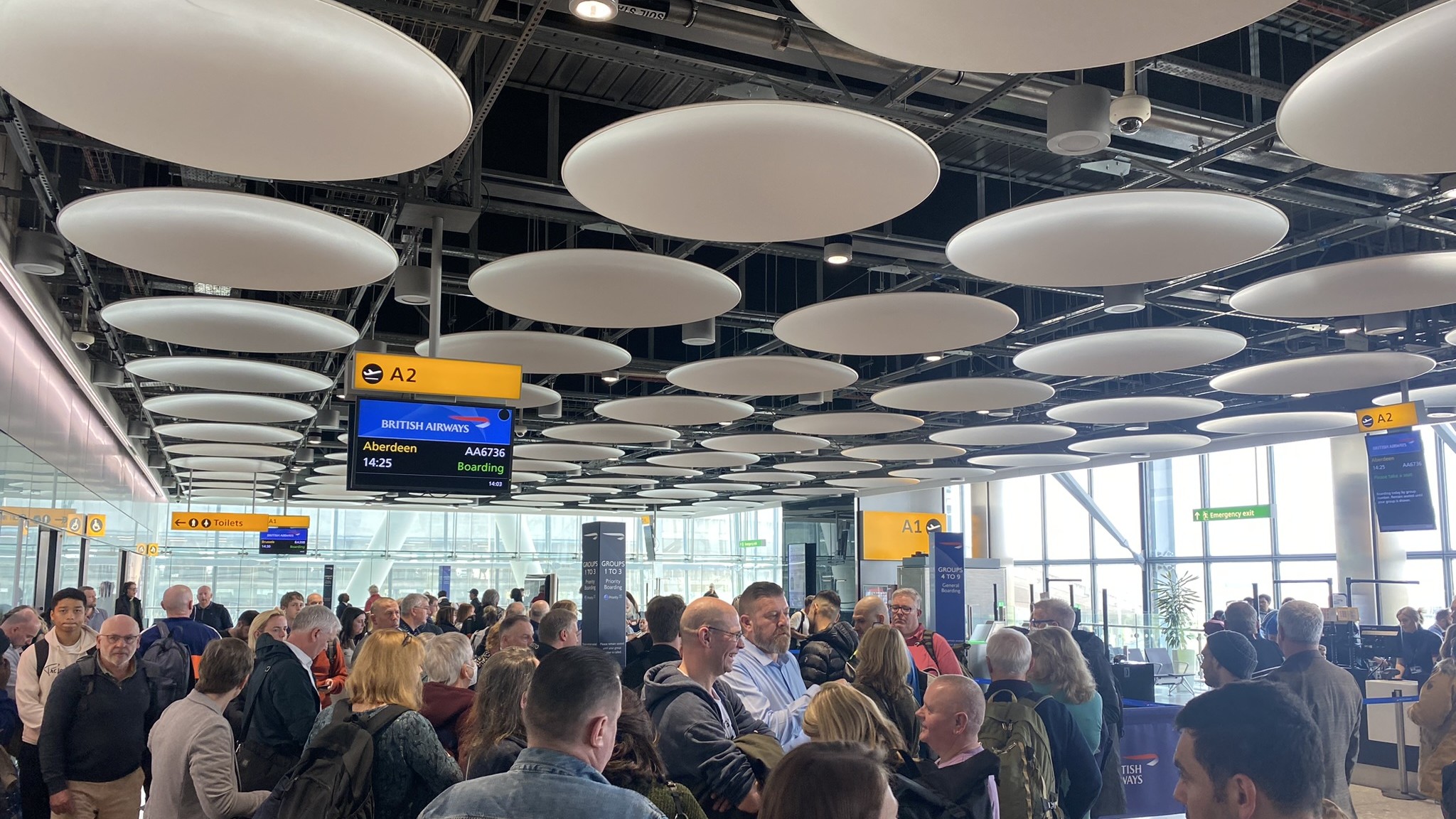
On Sunday evening I was standing at a boarding gate at Aberdeen Airport, doing what I always do at boarding gates now, which is watching the crowd and waiting for my moment.
British Airways board by group number. I am usually Group 2, occasionally Group 1 if I have upgraded. The process is announced clearly and repeatedly. Please remain seated. Please keep the gate area clear. Please wait until your group is called.
Nobody does any of these things. The gate area offers seating for perhaps five percent of the passengers on any given flight. The rest stand, shuffle, crowd the lanes, position themselves. They are not bad people. Most of them, in any other context, would hold a door, let someone go first, apologise for taking up space. Here they push forward with a quiet, anxious desperation, and they have learned, as I have learned, that following the instructions means missing your position, and missing your position means the overhead lockers will be full by the time you board. A full locker means your bag goes under the seat in front of you. If you travel weekly, as I do, with a laptop and a change of clothes in a rucksack that was never designed to fit into that space, you know exactly what that means for the next hour.
So we all do what the system has trained us to do. We ignore the announcements. We move when we judge the moment. We develop workarounds.
Last year, a man left his family, walked through the crowd, and put his face four centimetres from mine. He was shaking. I had muttered something as I passed him, which was the thing that lit the fuse, though I hadn’t loaded the gun. The adrenaline hit me in a way I hadn’t felt since school. I was readying myself for a fight at an airport boarding gate, because the gate area was too small and the locker space was too tight and nobody at British Airways had ever been made responsible for the full human experience of boarding a plane.
He was embarrassed in front of his children. I was guilty despite having done nothing technically wrong. We were both angrier and more afraid than we had any reason to be.
That is what bad design does to people. It doesn’t just inconvenience them. It makes them into a version of themselves they don’t recognise and don’t want to be.
On this trip, for the first time I can remember, the BA app sent me a notification telling me the gate was known and that I should make my way there in good time. This was, by any measure, a basic function of a flight app. It was also the first time in eight years of weekly travel that it had worked for me.
Six weeks ago I wrote to BA Customer Relations. I described eight years of travelling with them almost every week, and the fact that their app has never once sent me a push notification. Not for gate information, not for boarding, not for delays. Nothing. I asked them to investigate whether something in their systems had failed to register my account properly.
They replied to inform me that I had not been downgraded, as I had travelled in the same cabin in which I was originally booked, which was Economy.
When I asked for a copy of my original complaint so I could understand what they had actually responded to, they told me they were unable to provide copies of previously submitted correspondence, but that my case had been reviewed based on the information available.
The information available was someone else’s complaint.
Three weeks ago I decided to port my business telephone number away from Vodafone. This is not an unusual thing to do. Businesses change telephone providers. It happens every day.
I am a technical person. I have worked in and around telecommunications for decades. I called Vodafone first, explained what I planned to do, and asked whether porting the number would affect my broadband service. They said it would not. I proceeded.
The automated email arrived twenty seven minutes before the porting confirmation. Sorry you are leaving. Vodafone’s system had already decided I was leaving everything, not just the telephone number, and had scheduled the cessation of my broadband service for the same date.
What the email trail does not capture is what happened next.
I had asked an AI assistant how to navigate Vodafone’s telephone system and reach a human being in the right team. It gave me a specific sequence to follow and a form of words that it said would route me to the sales queue, where someone with authority to help would be waiting. I followed the sequence. It did not work. The automated system talked over me, listing options I had not asked for, asking me to state my query in a few words, telling me it hadn’t understood, asking me to try again. I found myself shouting at my phone in my own kitchen. The phone continued, patiently, to offer me its menu.
When I eventually reached a person, he put me on hold for ten minutes. The hold music was the kind that has been specifically designed to make you feel that everything is fine and that your wait is both expected and normal. When he came back, he explained that of course the broadband would be cancelled when the number ported. The number and the broadband are always together. They always transfer as one.
I explained, as calmly as I could manage, that I had worked in telecommunications and IT for forty years. I explained that IP telephony has no fixed dependency on the physical infrastructure that carries the broadband signal. That these are separate services that happen to be bundled together for commercial convenience, not technical necessity. That there was no engineering reason why one could not continue while the other moved.
I could hear, in the silence that followed, the sound of someone reading a script that did not cover this situation.
He escalated me. I waited. I had a Teams video call to chair in twenty minutes. I chaired it. I called back. The automated system welcomed me again and asked me to state my query in a few words.
A manager called me back late in the evening. She was apologetic and genuine and completely unable to help. The telephone number and the broadband are linked, she said. It was genuinely impossible to change. I said I understood that this was probably an unusual case. She laughed and said she certainly hadn’t seen too many requests like mine.
She was a support person who couldn’t support. A problem solver who couldn’t solve. Someone had built a system so rigid that a human being sitting inside it, understanding the problem, wanting to fix it, was as helpless as I was. I felt sorry for her. I used to be that person, the one who could do the detective work, who had the complex technical understanding, who could find the fix for the unusual case. That capability isn’t valued anymore. The system only handles the usual cases, and for everything else it apologises.
The outcome was a choice between losing my telephone number or losing my broadband for a week. I chose to lose the broadband and find a new provider. Vodafone lost both services rather than one. Their automated process, designed presumably to reduce costs or simplify operations, had achieved the opposite of its purpose. It had driven away a loyal customer of many years, in a way that no human being involved in the process wanted or would have chosen.
I then spent several days coordinating between three companies, Vodafone, Voipfone and Zen Internet, none of whom could speak to each other, writing careful emails, managing timelines, delaying port dates, trying to close a gap that should never have existed. The humans at each company were helpful, prompt, and genuinely trying. Jordan at Zen. Lyndsay at Voipfone. The manager at Vodafone who called to apologise.
None of them could fix it. The computer had already said no.
In late June I stayed for three nights at a hotel in Kensington that Expedia listed as a three star property with air conditioning, breakfast included, and a twenty four hour front desk. I had been asked to extend my travel to London at short notice, the flight changed with only hours to spare, and I was packing while simultaneously trying to find somewhere to stay near the office booking that already existed. I found this hotel on Expedia, the same platform the office used, at what looked like a reasonable price for the area. I suggested it. The office booked it. The price had jumped to approximately two hundred pounds per night.
No good deed goes unpunished.
When I arrived, the bathroom towel was already on the floor. The complimentary toiletries were a previously used bottle of Radox shower gel and a bar of Dove hand soap. My first room was in the basement, with a barred window opening onto a below street level well area filled with rubbish and building materials. I was moved to Room 6.
The air conditioning unit in Room 6 was leaking when I arrived. Staff were aware of this. A towel was provided to catch the drips. By the first evening the flow required a cup, which filled in approximately thirty minutes. The unit sat directly above the bathroom door. Overnight the AC stopped cooling entirely, leaving the room at twenty eight degrees with no ventilation and a persistent smell of damp. I was given a bucket. Staff told me that engineers had been attending the property almost daily due to widespread AC failures across multiple rooms.
There was no breakfast. The reception was unmanned on multiple occasions. Housekeeping did not occur during my three night stay.
A guest named Jennifer had stayed the week before me. Her review described black mould throughout her room, her husband’s asthma so severely affected that they nearly required hospital treatment, a refund refused after a dispute with management lasting over an hour. I believe I heard that dispute through the wall. Her account is entirely consistent with what I experienced.
I submitted a formal listing dispute to Expedia identifying five specific inaccuracies between the listing and the reality, star rating, air conditioning, breakfast, front desk, housekeeping. I provided photographic evidence. I offered video evidence. I wrote a detailed guest review. I reported the health and safety conditions, the mould, the leaking AC unit, the fire escape concerns, to the Royal Borough of Kensington and Chelsea Environmental Health.
Expedia’s response was to inform me that the listing did not appear to contain illegal content and to suggest I call their customer service line. They had processed my listing dispute through the wrong channel entirely.
The Environmental Health Officer visited, inspected rooms 4 and 6, found no concerns, noted that the AC unit had a temporary fix in place, confirmed the yards were clear of waste and the fire escape unobstructed, and closed the case.
The hotel is still listed on Expedia. The star rating has been corrected from three to two. A guest named Derek, who stayed ten nights in June, was moved between five different rooms. Nothing worked in any of them.
Expedia’s AI summarises guest feedback by noting that the air conditioning at this property often fails to function properly.
The system noted the problem. The system filed the problem. The system moved on.
In January 2024 I bought a plug-in hybrid car. It cost more than the first flat I owned.
The decision was partly forced. Aberdeen’s Low Emission Zone made our previous car, a diesel that had served us faithfully for years and taken us on holidays across the UK, unviable for the city. The new car was supposed to be a step up.
Every time I turn on the ignition, the first thing I see is a greeting for my wife. This is because the VIN number can only be associated with a single user profile, and since her name was registered first, it greets her regardless of who is driving. The dealer’s solution was straightforward: re-register with my own account. I won’t do that. It would feel like erasing something. So every morning I am welcomed by my wife’s name in a car she finds uncomfortable to drive.
When the petrol engine runs, the gear changes are clunky and unpredictable. The braking feels wrong, as if the engine is fighting the car rather than working with it. The ABS activates when turning right at a familiar junction near our home. Twice the car has lost drive entirely for a moment while transitioning between electric and engine power. The collision mitigation system has triggered false alarms while reversing into our own driveway.
When I reported these issues to the dealer, I was told everything was fine.
The washer fluid warning light activates after a single use of the washers. The service reminder has displayed continuously since the car was serviced two months ago. No combination of button sequences retrieved from YouTube has cleared it. There are almost no physical buttons in the car. Everything is a touchscreen, which means adjusting the seat heating or the temperature or turning down the music while driving requires pre-planning rather than a glance and a touch.
On the day I drove my son to Glasgow for a university open day, the car broke down completely. The AA attended. The solution was to disconnect and reconnect the battery. The whole process took an hour and a half. Switch it off and switch it back on again.
This is a car that cost more than my first two-bedroom flat, purchased in the 1990s. It greets me with my wife’s name, warns me about a service it doesn’t need, cannot tell me reliably when the washers are empty, and once stranded me on the way to my son’s university open day.
The dealer checked everything and found it was fine.
I want to be clear about what I am not saying. I am not saying that every company is corrupt, or that everyone working inside these systems is indifferent, or that nothing works anymore. Jordan at Zen was helpful. Lyndsay at Voipfone was helpful. The manager at Vodafone who called to apologise was genuinely sorry. The BA staff make the announcements. Sean Pender from Environmental Health visited and wrote back promptly. The people are, almost without exception, trying.
The problem is not the people. The problem is what the systems they work inside have been optimised to do, and what they have been optimised not to do.
Somewhere in the last thirty years, across almost every industry simultaneously, a decision was made that the cost of quality was too high. Not as a single moment of choice but as an accumulation of smaller decisions, each one rational in isolation, each one justified by a spreadsheet, each one invisible until you are standing at an airport gate at six in the morning with your heart rate elevated and a stranger’s face four centimetres from yours, or waiting on hold for the third time while an automated system tells you your call is important.
The man at the boarding gate was not angry at me. He was angry at something he couldn’t name. I know this because I am angry at the same thing, and I have been for years, and I have the advantage of being able to articulate what it is.
It is not that things are expensive. I understand that things cost money, that quality requires investment, that skilled people deserve to be paid. I am not asking for cheap. I am asking for honest. I am asking for the thing I paid for to be the thing I receive. I am asking for someone to be responsible for whether the experience of using a product or a service is actually good, not just whether the cost of delivering it is sufficiently low.
That is not a radical demand. It is the minimum condition for a functioning economy and a functioning society. When it disappears, people do not simply accept it. They get angry in airports. They leave reviews that nobody acts on. They call environmental health officers who visit and find the temporary fix is in place. They cancel their fasting app subscriptions. They write articles.
I do not want burning torches. I want someone, somewhere, in a boardroom or a strategy meeting or a shareholder call, to ask not just what this decision costs but what it costs the person on the other end of it. I want quality to be a metric that matters. I want value to be something you can still choose, if you are willing to pay for it.
Right now, in too many places, you cannot. The computer has already decided.
And the computer says no.
On This Site
An Open Letter to British Airways — Memoria: an open letter written in response to the experiences described in this article, preserved here because it needed to be said somewhere.