This bank holiday weekend was one of the warmest on record in parts of the UK. Not here, but warm enough that my wife and I walked in Hazelhead Park on Sunday afternoon.
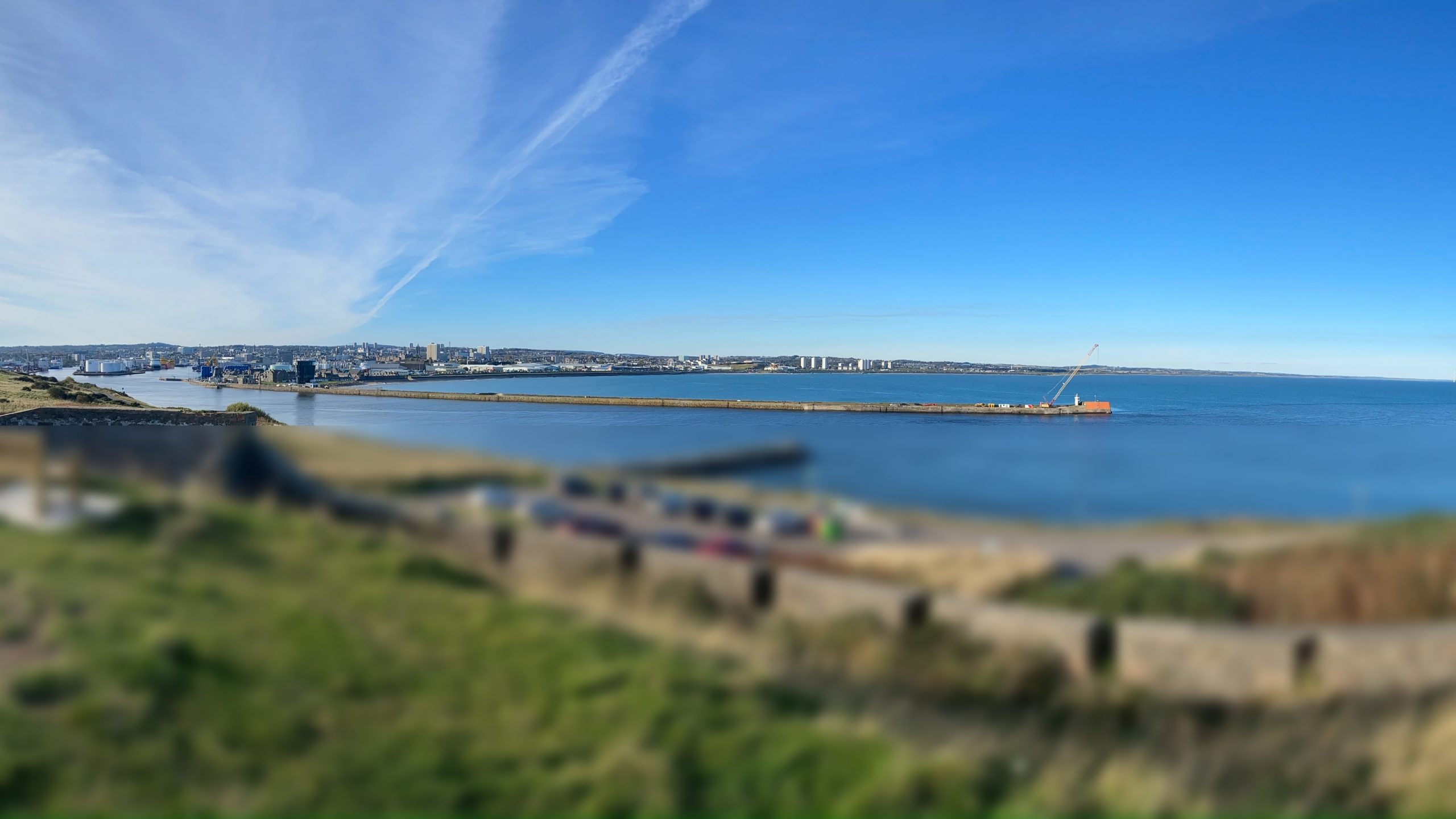
As I reached the garden that holds the Piper Alpha memorial I could see the three bronze figures and, as I walked toward them, I found myself studying them. I noticed that the figure in the survival suit didn’t look quite right to me, and then immediately wondered whether it was disrespectful to think that. I thought about the artist who had been commissioned to create something so significant, and the weight of that responsibility. The paused-in-time positions of all three figures look slightly peculiar too, and I’ve never been sure whether that’s intentional, that sense of a moment frozen rather than resolved.
Someone had left cut flowers by the central plinth. Still in their wrapper, but several days old, the flowers all faded. I found myself wondering who had come recently, and who they had lost.
My wife commented that it would be a lovely place to simply sit and read. There was a man doing exactly that in the far corner.
The gardens were stunning, no roses yet, but the walls were surrounded by rhododendrons, many just beginning to bloom. Aberdeen used to win Britain in Bloom regularly, and you can still see why. Despite recent council cuts and reduced staffing, the few people who remain are clearly doing everything they can to care for something worth maintaining.
The city around it is not faring as well.
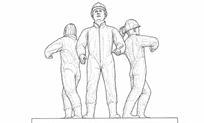
I was studying at university when Piper Alpha happened on the 6th of July 1988. Like most people in Aberdeen, I didn’t lose anyone directly, but I knew people who did. Nearly forty years later it is still part of our DNA.
My first proper job, not counting my time at Ritzy’s, at the time billed as Scotland’s Number One Nightclub, where I spent my nights supervising the bar until 2am and my days doing the rather less glamorous cellarman work, was a junior admin and logistics role working offshore. I was organising flights, managing schedules, reviewing and consolidating timesheets, and sending out job packs in the early hours. I had no illusions about my seniority but the projects I was supporting were part of the wave of safety retrofits that followed the Cullen Inquiry, including the installation of Emergency Shutdown Valves on platforms that had to be retrofitted to meet the new standards. I was twenty-something, coordinating crew changes and shuttle flights across a dozen platforms in the Indefatigable field, watching helicopters line up for the helideck at dawn and dusk like a scene from Apocalypse Now. You don’t forget something like that. It was astonishing.
What Aberdeen built in the decades after Piper Alpha was a culture where safety came first, carried by engineers, technicians, planners, administrators and support workers at every level, who understood that complex systems in hostile environments demand rigour and long term commitment.
When I was seven or eight, my brother and I used to walk through Aberdeen’s fish markets on our way to the beach. The scale of it was overwhelming, hundreds of people as far as you could see, boxes of fresh catch everywhere, a kabillion seagulls, and a smell that you could taste in the back of your throat. On one trip, towards the end of the morning trades, a man gave us some unsold fish wrapped in newspaper to take home. My mother tried to be enthusiastic. She had not been expecting her two kids to arrive back with raw, unfilletted fish.
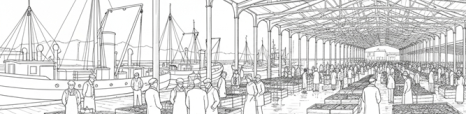
None of that exists anymore. The fish sheds are gone, the trawlers are gone, the hundreds of people on the quayside are gone. Aberdeen made that transition once before, from fishing to oil and gas, and whatever was lost, at least something came to replace it. The city that used to smell of fish became the Oil and Gas Capital of Europe. The question now is whether the next transition follows the same pattern, or whether the oil economy simply makes way for nothing.
When I read that the hydrogen buses were to be sold, I felt a depth of sadness far harder than a story about public transport ever should.
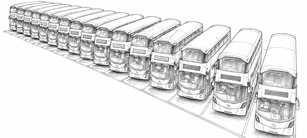
The programme was never really about buses. Aberdeen’s initial fleet of 15 hydrogen-powered double-deckers launched in 2021 were the first of their kind in the world, backed by £8.3 million from Aberdeen City Council, the Scottish Government, and the European Union [1]. A further 10 buses followed under a £4.5 million Scottish Government award [2], bringing the total to 25 vehicles. The real ambition was larger still, a functioning hydrogen production and refuelling hub at Kittybrewster that could anchor a wider energy transition strategy, developed in partnership with BP [3].
When the refuelling stations at Kittybrewster and Cove developed technical failures in 2024, parts proved difficult to source and the infrastructure was nearing the end of its operational life. The decision was made not to fix or upgrade it but to wind it down. The buses sat. And in early 2026, the council confirmed they would be sold [3].
That decision was not a verdict on hydrogen as a technology. Hydrogen is energy, clean, renewable, and storable in ways that batteries are not. The world’s serious energy thinkers have not abandoned it regardless of the current enthusiasm for batteries. The failure at Kittybrewster wasn’t a failure of nerve. It was a failure of vision at the level where it mattered, an idea with real strategic and environmental ambition behind it, reduced at the point of crisis to a narrow operational question, a broken refuelling station, a budget line, with nobody positioned to see, or care, what was actually being abandoned.
The people who built that infrastructure understood consequence. The people who decided to dispose of it rather than repair it made a different kind of calculation. It is the same calculation, made again and again, that is hollowing this city out.
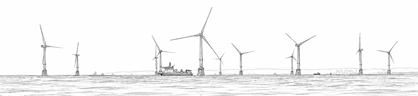
Look out to sea from Aberdeen’s coastline on a clear day and you can see the European Offshore Wind Deployment Centre, eleven turbines turning off Balmedie, visible from the shore, with a combined capacity of 96.8 megawatts [4]. It looks like progress. It looks like a city pointed in the right direction. They were manufactured by Vestas in Denmark.
That is not a criticism of the project. It is an observation about the gap between what was bought and what was built here. Aberdeen watched turbines arrive from another country’s supply chain and installed them off its own coastline. And then, extraordinarily, the dominant public conversation about those turbines became Donald Trump complaining about how the “windmills” spoiled the view from his golf course at Balmedie.
A city that spent fifty years engineering the infrastructure for one of the most complex and hostile industrial operations in human history, that forged a safety culture from catastrophe, that once filled its harbour with the noise and smell and life of a working fishing industry, ended up debating wind turbines reduced to one man’s grotesque entitlement over the view from his golf course.
That gap between what Aberdeen is capable of and what it ends up discussing is not a political observation. It is a description of what happens when there is no strategy, only reactions. Tactical decisions made in isolation, one at a time, with no thread connecting them to anything larger.
The engineering capability that exists in Aberdeen right now is not hypothetical. Subsea systems, remote operations, corrosion science, high-reliability mechanical engineering, offshore logistics. These are not legacy skills waiting to be retired. They are exactly the capabilities the next fifty years will need, if anyone decides to use them seriously.
Aberdeen became the Oil and Gas Capital of Europe partly through good fortune, the oil was there and the timing was right, and partly because enough people had the can-do attitude to seize that opportunity when it appeared. That’s a different thing from vision, and it matters because the next transition won’t have the same luck attached to it. It will need to be deliberate, chosen rather than simply seized. The safety culture that followed Piper Alpha wasn’t an industry choosing to do better. It was mandated, forced through inquiry findings and regulation that the industry had not prioritised, and it only became real because the people implementing it, engineers, technicians, planners, took it seriously rather than treating it as paperwork. The council workers still tending the gardens at Hazelhead despite the cuts are doing something similar, on a much smaller scale, making the best of what they have despite being given little support to do it.
I’m not writing this because I have the answers. I’m writing it because I walk past those bronze figures in a beautiful park in a city that is visibly decaying, and I think about me and my brother walking through a fish market that no longer exists, and I don’t know who is supposed to decide this matters enough to act. But somebody has to.
References
[1] Aberdeen Hydrogen Bus Fleet to be Sold Off – Aberdeen Business News
[2] Funding of hydrogen buses and bus fares in Aberdeen: EIR release – Scottish Government
[3] Aberdeen’s axed hydrogen bus fleet cost almost £14 million – Aberdeen Business News
[4] European Offshore Wind Deployment Centre – Vattenfall